Showing posts with label retirement in Mexico. Show all posts

Wednesday, January 9, 2013

Navidad – Going To Mexico


Our recent annual Posadas Parties gig in downtown Los Angeles ended quietly on December 24th.  As we were setting up several employees asked if the evening would end earlier than the other nights, and Yes, we said. We used less equipment and smaller speakers, and shortened the times between events, so that we ended about 9:15 instead of at 10 p.m.
Some of our equipment, waiting to be stored - up two flights of stairs - the life of a musician!
We trudged up and down stairs and put away our equipment in the storage room. We said our goodbyes to the dancers, the puppeteer and the employees, and drove to our motel for our last night.

In the morning we packed up our equipment and clothing, and went to a local pawn shop to purchase a drum machine we had spotted similar to the one we like to use for recording. We then drove to a cousin’s house near Covina where we enjoyed a wonderful meal with ham as a main dish (thank you, Sylvia!. In spite of all the excellent meats available in Mexico, ham and turkey are two things that just are not of the same quality. I am not embarrassed to say that I had several many servings of ham. I had an extremely enjoyable conversation with Sylvia and her lovely daughter while the daughter made guacamole as Christmas gifts for her friends. They were so attentive I probably talked way too much. I do miss having women friends to talk to, and I probably totally dominated the table talk.

As the afternoon wore on I began to cast glances at the clock and fret a little about leaving on time. Our car was due back at the rental agency in San Diego at 9 p.m., and I hazarded a guess that it would be perhaps a three-hour drive. We left about 6:45 after our goodbyes. While I kept driving at a steady pace for about three hours, Chon napped off and on.

We were on an unfamiliar freeway, and it just didn’t feel like exactly the right direction. When I began seeing signs for San Diego, but not for the airport, I called my sister, who was on the receiving end of a snow-and-ice storm in Arkansas. She speedily looked for directions to the airport (she is really, really good at using the computer), and told me if I saw highway 163 I should take it. As her words came through the phone we were just arriving at the off-ramp, and we zoomed onto it. Her directions were perfect and in a short time we were near the airport; we gassed up the car, checked it in and re-packed our things.

I may not have mentioned that one part of our luggage was a large box (The Box) with digital recording equipment we had purchased in Los Angeles. Chon packed it with clothing for additional protection. It had carrying handles, but it was quite heavy and rather awkward. In addition I was carrying a bag we bought at a thrift shop because it had wheels for ease of movement.

Although we had taken the Volaris shuttle from the Tijuana airport to the San Diego airport, we weren’t exactly sure how to catch it back to the Tijuana airport. Although I was fairly sure of the location, I hadn’t really thought about the lateness of our return, and wondered if it would come. An extremely rude taxi driver tried to convince us that my directions were wrong. We showed up, though, at the Amtrak station, and I got directions for the shuttle stop right outside the door. It would arrive, the attendant told us, at 11 p.m. Our flight was scheduled to leave at 1:10 a.m., and we were beginning to feel pinched for time. That is to say, this is when both of us were feeling that pinch; I had felt concerned since, say, about 5 p.m. There was one other person besides us at the shuttle stop, a young man who told us HIS flight was leaving at 11:45.
Our luggage under street lights, outside the Metro Station in San Diego, CA. See The Box?
We looked at each other wordlessly. IF the shuttle arrived at the scheduled time, and IF it took zero minutes to officially cross the border, it still would just not be possible for him to make his flight because of the 20-or-so-minute drive to the border. He suspected it, and we knew it. He asked if we would like to share a taxi. There was one parked a half-block away, and before Chon went to ask if it was available, I asked him to make sure the driver wasn’t a complete A. He wasn’t, and it was available. He wanted $50 to drive us to the border, and the other passenger offered to pay half.  That made OUR taxi ride cheaper than taking the shuttle! We got a strong young guy to help carry The Box, and HE got at least a chance to make his flight.

We raced to the border, the cab driver probably in a hurry to harvest more work on this busy Christmas night. The cabbie had lied, however, when he told us that it wasn’t far for us to walk to cross the border; “less than a block”, he said. We tumbled out of the cab and unloaded our gear and began to walk on the new pedestrian path across the border. My bag, the one with wheels, would begin to rock wildly if I walked speedily or held the handle too high, so I brought up the rear.

We sweated our way along the well-lit, smooth sidewalk that led to a small brilliantly lit room where a sleepy-eyed female border agent asked us where we were coming from, and going to. Chon told her that the three of us were a band, and we were making a regular border crossing to play at a party. She waved us past her with a bored smile.

And then we walked, and walked. And walked some more. The sidewalk became a bridge. With many switchbacks. Chon and the young guy made several changes of sides of The Box because their hands hurt. Several times we passed a middle-aged gringo (and he passed us), and one of those times he asked us, panting, if we wanted to share a taxi. Yes, we did. As we finally arrived, panting, at the taxi parking area, we beckoned to him to hurry so he could ride with us. The taxi driver quoted a $20 price (yes, $5 apiece) and amazingly, loaded The Box and some other luggage into the truck and tied the trunk lid down. The four of us piled in, and passed around our smaller bags so that we could fit.

We started off for the airport, and every time we drove across a pot-hole the trunk lid would bang and the gringo with us would mutter “bad shocks”. We made it to the airport in record time, and the young guy and Chon picked up The Box again and carried it to the luggage scanner. We made it through that first hurdle and I had my visa checked. The young guy began to slink away, and Chon called him back to haul The Box to our check-in line, where he promptly and efficiently disappeared. Who could blame him? He DID make his flight, though.

And WE pushed The Box through the lines to the check-in, where we paid for the extra weight. Then we headed with our backpacks to the security check, where we were told that we could not carry our (brand-new, extra-heavy-duty, expensive) instrument cords in our carry-on luggage. (What???? No electrical cables in carry-on? That is not something I have seen listed as being prohibited by the airlines.) I waited while Chon ran back to the check-in counter where the airline workers told him to leave his backpack with them.  As this was simply not an option (great NEW backpack designed for computer, with a fine drum machine inside), he talked them into leaving only the cables with them, and returned cum backpack to the security check-in, and then, finally, we were through, and the rest was easy.

The Volaris flight took off and arrived on time (congratulations, Volaris!), and when we arrived I had my first opportunity (??) to help carry The Box. After only a few seconds I was so relieved that I hadn’t been the one drafted to lug it all the way across the immigration trails!

A friend picked us up at the airport, and as we headed for the highway to take us home, there were hundreds and hundreds of urracas, boat-tailed grackles, in enormous parvadas , flocks, flying overhead.

We got home about 40 minutes later, unloaded our things and went to sleep for four hours.


Friday, May 4, 2012

BANKING

I won‘t say “only in Mexico”, but see what you think about this story.

Chon’s family has had a long-running problem with officials in regard to the spelling of their last name. On Chon’s father’s birth certificate Vasquez is spelled like that: Vasquez.

Chon’s sister Elena, who has historically spelled her last name Basquez, (yes, birth certificate and all) recently had problems with her medical insurance because someone misspelled her name when filling out an annual form; Elena didn’t notice, and her brand, spanking-new identification read Bosques. She couldn’t receive services for several months, and had to show her birth certificate and other identifications to get a new card. This took several trips to different offices.

Chon is enrolled in a government program for financial assistance for small farmers. It provides help for buying seed, etc. Last year at the end of May the people at the Procampo told him that they had opened a bank account for him, and he should go to the bank to confirm the account. He decided he wasn’t interested in the account. But this year they told him that they had deposited his check in the account. So we went to finalize the account so he could with draw the money when we need it for farming expenses.

At the Accounts  desk the woman reviewed his documents and said. “Procampo has misspelled your name”. (As Vazquez.) She couldn’t officially open the account. She suggested that we get a letter from Procampo stating that no matter how his name was spelled, he was really him. We went right back there and got a very official-looking letter with a seal and an enormous, artful signature and gave it to the bank official. She said that she would send it to the main bank with copies of his identifying documents, and that we could return in three days. But not really three days, because of May 1st, Labor Day. We waited a couple of extra days, because - well, just because. When we returned yesterday the same woman was not there, so Chon re-told the story  to another person. She said that headquarters had not made the spelling change.

She suggested that we go to the branch where the account was located, and see if they could help. (Why didn't they just tell us where the account was located in the first place, I wondered.)

We went there and the accounts woman looked at the documents and said,”You just need a replacement card for the one we gave you originally.” (They hadn’t. Or Procampo hadn’t, or - whatever.) She said, “Your name is correct, so I’ll make you a new card.” We glanced at each other. Correct?
We wisely kept our mouths shut, and in a minute or two she handed Chon his new card and a PIN (here it’s a NIP). And that was that. As he signed for the new card he cautiously asked how he should sign it. The woman casually told him that it didn’t matter. He should sign it the way he usually signs it. Vazquez.

Wednesday, April 25, 2012

I LIKE NOPALES

I like nopales. OK, they're not for everyone, (their texture is a bit like okra) but I really, really like them.

Our next-door neighbor Doña Elena has practically no income, but she enjoys bringing us little gifts, usually food. Last week she brought two glasses filled with red gelatin, and some nopales she had harvested and prepared herself. Yesterday when we were sweeping the street in the early morning she asked me how we liked the nopales. We had forgotten about them, I’m afraid, but I told her they were wonderful - very tender. Right after that I got them from the refrigerator and prepared them so I wouldn’t have to feel so guilty.

Nopales are the pads of the prickly pear cactus, and they are low in calories and contain modest amounts of vitamins and minerals.
I cut them into strips and boiled them. As they are boiling, nopales make lots and lots of bubbles, and you have to tend them so they don’t boil over. When they are cooked you drain them and cool them quickly, and throw away all the now-slimy, bubbly water.

After they are rinsed they are not (so) slimy, and you can prepare a salad with them (with chopped onions, tomatoes and cilantro), or use them like a vegetable in main dish recipes. I asked Elena if she wanted to use them and she said yes.

Today she cooked some very pretty flor de mayo beans - they are a pinkish pale yellow, and cook fairly quickly, and then she added the prepared nopales.

I could scarcely believe it last week when a truck came through town with large red tomatoes for sale for 4 pesos per kilo. We bought 2 kilos, and have been enjoying sliced tomatoes often. (Four pesos is less than forty cents, and a kilo is well over two pounds  - figure it out!)

And today i sliced the last two and served them with the beans and nopales, and toast. What a wonderful meal!

Monday, April 16, 2012

The Friend Connection - San Miguel de Allende


Michael, My Friend, I’m so glad I got a hold of you three days ago! I called Richard but he hadn't set up his voice mail. THEN I called Beth as you suggested and there was no answer, but I thought maybe she couldn’t get her phone in time. I thought what a bummer it would be to just tell you lamely “Well,we just couldn’t get in touch.” and I called her back, and she picked up!

Richard suggested we meet them in front of the “Parroquia” there in San Miguel, because they would be there in three minutes or so...We had to drive down from an overlook where we were, looking down on the city. We parked where we thought we were within walking distance, and asked directions from two women, obviously from the States. One told us we had about a fifteen-minute walk, but, well, you know us - we were there in about 5 minutes, I think.


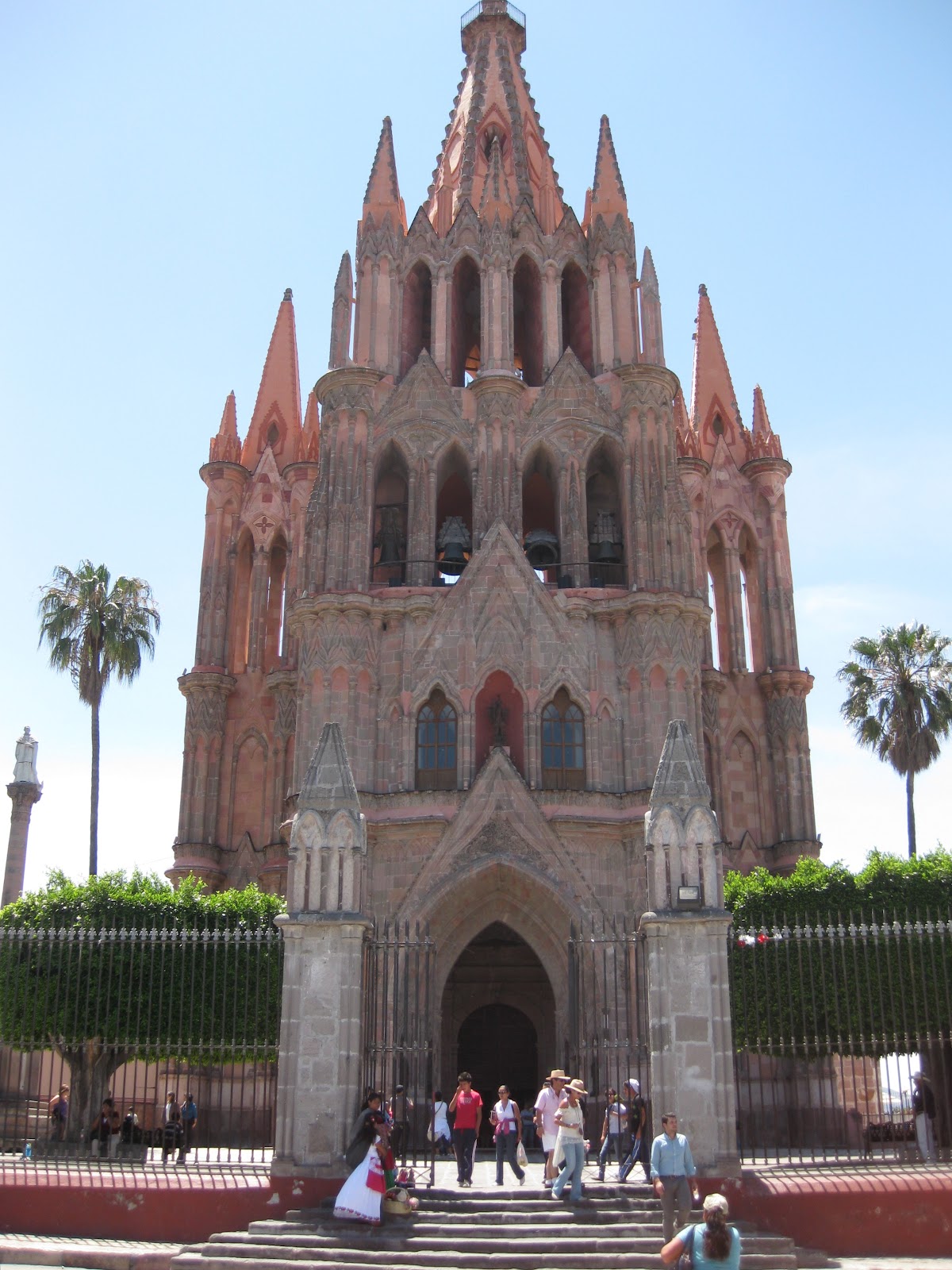
Every town and city here has a “parroquia” or two and you must ask the name. But in San Miguel there is only one Parroquia. It is not a modest building. It is directly across from the Jardin, and things were a-hopping when we arrived. There were many, many tourists, and small Indian women selling colorful toys and bracelets and other things from trays they carried.


And we found Richard right away. When we had passed a park earlier on our hike from where we had parked, we saw a tall man with a T-shirt and shorts, and Chon asked “Could that be Richard?”  No, that was not Richard. THIS is Richard! T-shirt and shorts, indeed!


And David and Beth were there, too, very friendly and companionable right away. I felt comfortable after feeling just a little anxious about finding them.

Richard had Plans. He suggested an exploring sort of walk around a few blocks, and it was quite enjoyable, including an art gallery with a friendly artist - “No photos, please! I’ll have to charge you $500!” Richard obediently deleted the pictures from his camera. Chon was looking for information about legal matters, and went into an office and Richard accomodatingly said not to worry, that they would wait in a local restaurant/bar. We took only a couple of minutes, though - most things were closed because of Holy Week - ane we met up with them right away, and had a margarita (two for the price of one - 80 pesos, less than 7 dollars!) And they were delicious, and seemed pretty strong on empty stomachs, so we had some laughs and got to know each other a little bit. I was comfortable with Beth right away - a different kind of artist, a classical ballerina, and teacher.

Soon we pushed on, and visited the local library, well-supported, Richard informed us, by the local gringo population. It was quite attractive, and busy for its small size. There were English lessons happening, and lots of posters announcing upcoming events of music, reading, and book sales.

The streets were old, of stone, and it seemed like everywhere you looked there were beautiful colors and images. Old doors, colorful houses and shops, stones, brick, and lots and lots of people in vacation mode for Holy Week.

Richard knew “a nice spot right around the corner” and we went to order the house specialty, chiles rellenos nogados. They were stuffed chiles with a lovely sauce of walnut cream. They were wonderful - sweetish, stuffed with spiced, ground meat with a few raisins. Chon and Richard ordered the “hotter” version, which reportedly was not hot. The sauce topping the chile was almond and cream. Goodness! A lovely meal, with crunchy French rolls and butter, and a bottle each of the house red and white. The conversation was wonderful, which I enjoyed nearly as much as the wonderful meal, having spoken English almost exclusively with Chon for more than a year or so...

We needed to head home by that time, a pleasant two-hour drive, having said we would return the next day. The business we needed to see to was not completed, the American consulate having closed only a few minutes before we arrived.

The next day we left a little earlier, and arrived at the consulate around 10:30 in the morning. The consul assistant spoke with us only very briefly, saying “No, you do not need ANYTHING from the consul. Stop by the ministerio publico who will give you a list, and then go to the Officina de Migracion, which will give you a different list of requirements. Since it was Holy Week, the ministerio publico was closed. The immigration office was open, but the line was too long for me to wait for the list after I took a number and analyzed the number of people before me, each with a thick sheaf of papers.

We went instead to meet Richard, Beth and David at La Terraza, right next to La Parroquia. They had margaritas in front of them, and Chon ordered a coffee, heavily spiked with rum, with a name, nearly forgotten, “Tarugillo”, like “For Dummies” in Spanish. We heard about the trio’s morning walking tour, given by a woman who had written a lovely book about San Miguel with wonderful photos.
View of La Parroquia from La Terrazza

And for lunch? Richard knew of a very pleasant restaurant right around the corner, owned by a Frenchman. Everything was beautifully served, and delicious: Milanesa steak, salad, with a beet salad as well, chicken in almond sauce, tacos. The young waitresses were pleasant and attentive. And Richard introduced us (well, me, anyway) to a lovely drink, kir, that I had heard about before, but never had the opportunity to sample.

We continued our visit in the lovely and comfortable jewel of a house where our trio of friends were staying - the home of a designer who rents it by the week to lucky travelers. Each space had natural light from above, from skylights (tragaluzes). The furniture and color and art was very beautiful and comfortable.


We needed to leave at 3, but we stayed until nearly 5:30, relaxed and happy from the wine and conversation.

About San Miguel de Allende: it is every bit as lovely as I had heard - flowers, stone streets and sidewalks, gorgeous colors and friendly faces. Everywhere you look there are beautiful vistas. Because of the large gringo population there are shops with different types of clothing and fabrics than can normally be found in Mexico, wonderful food, and thanks to Richard and our new friends David and Beth, comfort and relaxed enjoyment. When we travel to places it is nearly always because of some kind of business, and we don’t take the time to explore. Our two afternoons were like a vacation for us. Thank you, Friend Connection!!

Thursday, February 16, 2012

BIG TOWN, SMALL WORLD

Close to the post office in San Pancho


I am waiting to receive a document I need in Mexico. The fee for UPS delivery was $101!! Instead, it was sent US Postal Service ($45!). The address I had given was our street address for UPS use instead of a post office box number. Not much mail at all comes to our little town, and we decided to ask at the post office about twenty miles away if the document might pass through there, and if so, might they stop it there and put it in our mailbox. Yes, they said, and yes.

The Jardin in San Pancho during Christmas. There are city offices to the right.
The population of the town our post office is in is over 113,000. I am the only person with my last name that they know of. The eleventh most common surname in the US.

Thursday, December 15, 2011

ANNUAL CHECKUP

I love the pointillistic effect of a Blackberry in poor light!

We have been here in Mexico off and on for over a year, and I thought a general examination might be in order.

PERSONAL
I am happy here. There is really nothing I miss about California life., with the exception of a few wonderful people, and hot water. The bathing water that the family here calls “calientita” is really not even warmer than my skin.

My job as a high school choral teacher was stressful. Each year when I began the year I wished I was not aware of how much hard work was ahead of me. My work here is enjoyable. I like caring for our house. I never considered myself a good housekeeper, but the daily sweeping and mopping of floors is not unpleasant. The frequency means that there really isn’t a lot of dirt. It’s quick and everything smells good afterwards. I’m trying to enjoy dusting as well.

I still don’t cook here - Chon’s sister does that. Since I like to cook, that has been a minus, but still, there is a definite ease of life when you only have to heat up food when it’s dinner time. After we return from Los Angeles we are going to refresh the kitchen with new tile floors and paint, and we intend to do our own cooking when that is finished; we are sending the small stove (with NO oven) to Chon’s sister’s house, and starting with our own electric oven that has been languishing in the patio (it’s 220 v, and, well, nobody has 220 here) or a new gas stove /oven. But maybe I’m getting ahead of myself here. In a check-up do you get to include future plans?

I don’t have many friends, but I think that might change when I am more fluent in Spanish. And about that - it is slowly becoming more easy to have conversations, although I have occasional brain farts when I can’t remember very common words. Maybe that will never change - happens in English, too!

FINANCES/PRICES
Since inquiring minds want to know, food and household items are LOTS lower in price than in the US. Medicines are rather expensive, but the doctor care I have experienced is efficient,excdellent, and inexpensive. For most people here, it seems expensive, but compared to the California health care I am familiar with, it’s very low-cost. A doctor’s visit is less than $40. A brief, efficient, and very state-of-the-art hospital visit for Chon’s sister to remove gall-stones was completed in about three hours, and cost about $1,500. Really.

Food/groceries are good, and inexpensive.

Mattresses cost about a third of what they cost in the US.

FARMING AND GARDENING

We harvested our fields last month, and made about a 50% return on our investment in seed, tractor work, and labor, and we are opening a savings account to keep the money we made for next year’s farming expenses (it costs a lot to plant and fertilize).
Our garden was a success, but will be much better next year. We were casual in our seeding, and the result was overcrowding. We got a great harvest of zucchini (and lots and lots memorable meals with zucchini flowers). The poblano chile plants, now freed from the shade of the sprawling tomato plants, have now set on tiny chiles. if we don't get a killing frost, who knows! Chiles in January?
WEATHER
Here in central Mexico the weather is temperate. That doesn’t mean that it is warm all the time. Lately it has been quite chilly, with temperatures dipping well into the 30’s some nights. When we brought clothing here, I was told to bring sweaters. Now in December, I’m glad that I did.

HOME IMPROVEMENTS
We created some space - a new bedroom and bathroom for Chon's mother (the old bath is outdoors and down a step, making it difficult for her to navigate). 
We have a new studio for practice and recording. And a stage on top of our garage, for performances. (Years ago we began a tradition of performing for the town. Come see us on New Year's Eve!)


Does he look like a guitar god?
 AUTOMOBILES/REGISTRATION
We finally got the registration papers for our large truck. We use it mostly for band equipment. It took months to get this task done.  There are a bewildering number of laws and rules about importing  cars to Mexico. The truck qualified, but it evidently had some customization that was difficult to explain, or get cleared, or - something. Now, though, it is legal, and has Mexican license plates. 

TRAVEL AND DRIVING
We have driven many, many miles without trouble. When you cross state lines, however, you may well be stopped by federales, local police, or soldiers. We had an unpleasant experience in Nayarit when federales inspected our PT Cruiser and announced that they had found a marijuana seed in the back. They were insulting and a little scary while they kept us there for about half an hour. They pretended to be insulted when Chon offered to pay them for their trouble, but one of them took some large bills from the travel money we had with us.

Another time when we were stopped by some troops the young soldiers were very happy to accept a mordida although they took it hurriedly so that their superior officer did not see them; probably they didn’t want to share!

Driving here is - different. In general, the rules and laws are the same as the ones we all know and love. But the signs are different, and I don’t mean because they are in Spanish. They are placed differently; not regularized in placement, or color, or lettering. Sometimes you must make a turn before a sign, and sometimes quite a way after the sign. It can be a challenge to find signs for street names. Glorietas (or round-abouts) are a little scary at first, but then they begin to make sense. Just keep to the center of the circle if you are going all the way around, and to the outside lane if you are going to turn right. Many large cities have removed glorietas and replaced them with signal lights.

 UNWRITTEN RULES AND ETIQUETTE
I can’t give myself a high mark in this, but it is improving. Here’s an example: if I were at my home in California and a visitor was seated on my couch, I would go sit next to them to show I was happy they were there, and that I wanted to visit and be sociable. Here, in Mexico though, if someone is visiting and I go to sit with them, in a few minutes they get up and go. A territorial thing? (Sometimes useful!)

I think this was quite random, but that’s what I can think of right now for my checkup, and I’m just going to quit.

Sunday, November 20, 2011

NOVEMBER NINTH, 2011


Around midnight last night I could hear Chon moving around the room. He said he heard the church bell ringing “doubles”. That is an announcement of death. He went out to the street but saw no one. Later on, very early in the morning, we woke again, hearing bells.

Tio Kiko was waiting at the door at sweeping time. He went in, as he always does in the morning, asking about Socorro (still asleep) and Chon (still asleep). He has to check anyway, and is not satisfied until he finds their doors closed. Then he told me that his compadre Enrique died in the night, and his body was there at the house. This was not really a surprise, as they took him yesterday to the hospital for the umpteenth time. He lacked three weeks of reaching his ninetieth birthday, and his many serious health challenges had kept him bedridden for years.

A few minutes later, the news came that Don Geronimo also died last night. The bells we heard early in the morning were from the next rancho to the east, ringing his death.

The families in these small towns are very closely related. Don Enrique’s granddaughter who has cared for him for the last few years is also the granddaughter of Don Geronimo. Last night both  of her grandfathers died, and people are whispering about that. Nobody cane recall that ever happening before.


The first day of November brought sudden cold weather, freezing the crops, and people say that the cold weather brings “bad things”. The town is full of people suffering from colds and coughs. When we visited the fields in the morning we could see ice crystals sparkling in the sun. Chon’s sister Maria and his mother both have persistent coughs, and we have been sharing home remedies with them.

In the mornings Socorro says her morning prayers, interrupted by frequent coughs. She prays on doggedly in a strong voice. Coming to the end of some prayers, she continues on and on with more. She mentions death several times a day. She will be 90 in December, and suffers from a painful old knee injury, and right now from a constant cough.

Surely every adult in this little town will have many thoughts of death today and during the nine days of novenarios for the two old men who died the same night.

Monday, October 3, 2011

DEATH OF A LOCAL CHARACTER

Nena was born into a family of over twenty siblings. When Chon’s mother describes  Doña Mathilde’s and Don Luz’ multitudinous family she always says that Mathilde had 23 children; “tres vezes cuates”; three times twins.

Nena’s name is Maria Elena, but was never called that. She was always called Nena, a common nickname for Elena. Nena is also a word for “baby girl”. Nena was a twin, born second. She was always trailing behind - in everything.  She was not very healthy, and many things just sort of passed her by. As she grew to adulthood she became known in this little town as a viguera; a person with “bad” language. She liked to sit in front of her family’s little store, right across the street from us, and watch the world go by, trumpeting  insulting remarks about nearly everyone.

We met about 26 years ago, and I tended to avoid her; not because of her language so much, but because I was learning to speak Spanish, and Nena was harder than the usual to understand.  As I came to know her better, we would have conversations. I can’t remember her ever saying anything really rude to me, but whatever Nena said to anyone was heard by everyone within a couple of hundred feet because of her extremely loud and focused voice. She was absolutely incorrigible; loud, rude and crude.

Her health, never good, began to deteriorate to a serious level a few years ago. A small-boned person, quite short of stature, she began to carry more and more weight on her frame. She looked a great deal like a ball and she had to lean back to walk on her tiny feet. People said that she carried a lot of water weight, and evidently that was true. They said that from time to time the doctors would remove several liters of water from her stomach. That was not true, except for the amount.

Several times I heard family say that they just didn’t know what was wrong with Nena; the doctors had told her, but they just couldn’t remember what it was that they had said. She died of renal failure.

The last few months of her life she developed a continuous cough, deep, rasping, and painful-sounding. Here at our house we heard it a lot, because she would visit nearly every day. She especially liked to visit on Tuesdays when Chavela would come, because she often brought or prepared here delicious meals. Nena was the first one to the table, not only at our house.  She made herself welcome in many, many neighboring homes.


She and Chon would sometimes exchange mild insults. Other people would avoid her, or just chuckle and shake their heads, saying “Oh, Nena,”. In spite of her insulting and low speech, was quite religious, and attended mass when she could.

There was much conjecture about her coffin - how would they fit the enormous amount of flesh into it? As it turned out, the coffin was a normal one, with a glass window on top.

The funeral mass was very well-attended, and included many family members who had not visited for years. Many of the attendees had never been friends of Nena’s, but attended out of respect for the family, or bald curiosity.

There were fireworks Saturday night, when Nena’s body arrived from the hospital/morgue, and there were more fireworks early the next morning. These are typically rocket-type things that are shot into the air, and explode high above. You can hear the swish of the rocket as it flies.  There was also a mariachi group, only occasionally hired in our little town (mariachis are costly). Nena had a couple of favorite songs, and they were sung, along with popular rancheras, at the velorio.

As far as I know, although Nena told stories about bus drivers and musicians that she had her eye on, she never had a boyfriend. I doubt that she ever had a close friend. She never attended school. She lived much of her life in pain. She was truly one-of-a-kind, and I already miss her.


Wednesday, September 14, 2011

Pests In The Fields

This worm and hundreds of thousands of its friends can ruin a whole crop. 

They get right in the heart of the growing plant.

These are the birds that the pajareros try to scare away from the growing crops.

Sunday, September 11, 2011

Recipe For A Construction Acavamiento

A high-up colado being mixed on the street, and carried up to the fourth floor.

For our last big colado we planned a sort of manly party. We wanted it to be festive, as it was the last big construction task here at our house, and the colado was an historic one, on top of a fourth-floor room. 

The colado was to have started at 5:30 a.m., but not even the maestros were here then. However we were on the move before 4:30 in the morning.. We had full barrels of water where they were not needed, and zero barrels where they were  needed. 

We dumped buckets of water into barrels on the ground, from under the tejavan on the second floor. It felt rather festive, and personally, I felt slightly hysterical and silly.

About 6:45 a.m. I could hear the first sounds of shoveling in the still-dark street. The  workers seemed to have an air of excited energy, because they all knew there was to be “breakfast” served after the work. Our nephew Luis, a practiced butcher and large-scale cook had offered to make a Caldo De Carpa. This soup has well-known restorative properties, and is often served for la cruda, or hangover.
Luis, the cook
Sara, who didn't really look quite this "together" on this day, as she had locked herself out of her house, and arrived here by bus the night before, without her overnight things, because - well, I have her spare key.

While Chon stayed to manage the work crew (and play DJ for them) Luis and I went to a nearby town with Sara, our wonderful niece. Luis had set up a fogon, a little rigged up brick fireplace.

CALDO DE CARPA (Carp Soup)
for twenty-some hungry people:
In a 50-liter pot with boiling water, put
2 kilos of tomatoes, halved
1 kilo white onions, halved
2 kilos potatoes, in large chunks
a generous handful of chiles de arbol
2 kilos (a very large head) of cabbage, chopped in big chunks
1 kilo chayote, quartered
1 kilo joconoistle, peeled
1 fist-sized can of chipotle chiles
1 liter of tomato paste
a handful of salt
8 kilos (that’s a lot) of carp, in fourths
when the fish is almost done, throw in two or three handfuls of cilantro
We served 60 large rolls that all disappeared. We had purchased 2 kilos of tortillas that were pretty much ignored. There were also 24 large family-sized beers, and 4 liters of tequila.

I had noticed that Luis was pretty quiet while we were shopping  for provisions; he later confessed that he had never actually made the caldo before. He and Sara and I were stepping pretty lively for a while, chopping vegetables,  because the colado was finished about an hour earlier than we had thought. But the workers seemed satisfied to sit around in circles and I didn’t hear many complaints about the wait.


There were many rough handshakes and heartfelt thank-yous when the workers left around two p.m.

Saturday, September 10, 2011

PAJAREROS

Young, developing milo (sorghum) seed head.


Birds are a major cause of crop yield loss. Enormous flocks of blackbirds pass through central Mexico on their way north this time of year, leaving destruction behind. 

Many farmers who plant milo use plants that yield “bitter” seeds that the birds don’t like. 

But some don’t use this kind of seed, and all the fields are subject to bird damage. Here farmers hire pajareros to protect their fields. The tools of the human scare crows are shotguns with special loads, long whips, and voices. They shout “Aijo, yaijo.” crack their whips while striding around the field, and if they have them, shooting  their shotguns. The sounds start about daylight, and go on all day. This is the time of year for the pajareros to work. They earn good wages, and their voices and sounds of their tools color each  day.

Sunday, September 4, 2011

WORMS IN THE MILO


Well, when we looked for worms in our milo fields, we found some. It just seemed to me that there weren't that many. But we met up with some other farmers out there, and they looked. They left a message at our house: Worms! Worms! They can destroy the whole crop! Danger!.

Again, some workers found us. (Don Andres and Peña are working somewhere else right now.) Two brothers with farming equipment offered to work for us. We went to visit their machine yard, and drank an obligatory shot of tequila. They offered to bring an enormous tank of water to the fields, and their own experienced selves, to spray a foliar fertilizer and insecticide. We bought the prescribed bottles, and took them to the fields this morning. They showed up with a heavy truck, a very large tank of water in the back, and their spray rigs. They had one with a gas motor, and two that work with hand pumps.

Wondering about their names? Mechin, Monstro, and Chino. I think Mechin (sounds a little like Machine) is the older brother, maybe in his thirties, and then there's Monstro, who from his nickname you'd think he had some feature, difficult to overlook, that would make him look somehow monstrous. You'd be wrong, though, because he has a baby face and a quick smile. Their cousin Chino was the third team member. (Curly hair is called chino, and if you guessed that he has very curly hair, you'd be right). The three of them filled their tanks and sprayed our two fields in about three hours (not three days like the time it took for dry fertilizer and weed-killer).

The early morning was cold. The workers got very, very wet right away. Their pant-legs were wet. Their shoes were wet. They wore bandannas over their faces.  They mixed the liquids quickly and moved fast down the furrows. We were home right after eleven.

There was rain in the evening. The skies are so beautiful here in Guanajuato.


Saturday, August 27, 2011

IT REALLY IS A VERY SMALL TOWN


Here is an entirely gratutious photo of El Ojo De Agua, about a half-hour walk from here.

This really is a very small town - and you have heard all the jokes about small towns.

The night before last, at the end of a long afternoon, just before twilight, there was An Incident here. 

Our little rancho, El Pedernal, has two streets lined with houses. We live on the main street, the one you go straight down when you turn off the main road, the carretera. A couple of decades ago the streets were paved, so we no longer have a rocky street, but we do have two topes. These are humps that cross the road to slow down traffic.

In the evenings people tend to come out into the street to visit, and on the weekends maybe to buy a taco, tamal, or a snack. (And of course, there are the everpresent nightly borrachos, drinking in front of the store across the street).

I had gone out to the street just to gaze about, and I noticed right away that Something Was Happening; there were many people who had come quietly out to the street from their houses, and they were all looking up toward the carretera. I could see a pickup’s rear lights. Neighbors were murmuring “He backed up all the way down here, very fast, right across the topes! And then he went back up there, very, very fast!” I recognized the black pickup as belonging to a man who lives apart from his family, in the little community on the other side of the carretera. I asked “Is he mad?” The answer came, “He’s loco!!”

Someone had gone for his wife, and she and a grown son walked up to where the truck was parked. It was a rather busy time for local traffic, it seems, and every time a car or delivery truck would try to get around the black pickup, the driver would move it so that no one could pass. 

The streets were lined with more people, as if for a parade., but I noticed that nobody wanted to approach the truck.

Soon his wife reached the truck, and she stood there for a long time. The word filtered back to me “He’s asleep in the truck, with his arms on the steering wheel”. And “Even his strong son can’t get him out.” There were quiet discussions about what should be done - call the police? tell the local delegado?

In the end, not surprisingly,  nothing was done. I never heard the outcome. 

Wednesday, August 17, 2011

NOW WE ARE PATRONES

When you are need of workers, you don’t need to do much - they will find you. When we were in our fields struggling to control the Johnson grass, several men came to offer their services.

The first one was Peña. He came on his bicycle, and after the customary catching-up and joking around, he slid into a conversation about the farming. Peña is a very short man. he is not a Little Person, but he is really very short. He demonstrated how he would spray our weeds for us, walking around and miming holding a sprayer in his hand. Chon and Peña were friends long ago, and Peña’s nickname comes from a talented soccer player on the Mexican team years ago.

Soon another guy came on his bike, with his little boy on the handlebars. He was interested in the work, but he mostly walked about hunting for worms (plaga) on our mIlo plants.  It seemed as though he wanted to bring our spirits down, or maybe just to show off his ability to find problems.

A day or so later, another guy came bicycling out to us. He was Don Andres. He looked like the friend-turned-enemy bad guy in an old western. He got right to the point - he wanted work. He needed work, and he was the guy to do the work. Instead of hiring a tractor to spray our weeds (it was absolutely necessary - they were growing faster than the milo), we hired Peña and Don Andres. From our point of view, it was a good move. The tractor would have finished the spraying job in a half-day. It took the two men nearly two weeks. But, we figured, we were investing money in the town, and not in a big-time farmer and his equipment. As the days went by, we were impressed by the work the two men did.

Now we are patrones, and every morning we go to the fields to manage our little crew of misfits. For days and days we filled and hauled barrels of water to the fields for the weed spray, stirred and mixed the spray. The for two more weeks we took 100-pound bags of ammonium sulfate granules and place them strategically in the field so the workers didn’t have to go too far to fill up their bags (called morrales). Being a patron (or a patrona) means you have peones working for you. That's a word I'm having to learn to be comfortable with. But the peones are comfortable with it, even sort of bragging about their years as peones.

Chon is really good about deciding where each person should work, and about giving authority to some. He has to be very diplomatic. Right now Peña the very short man, is working with Don Andres, the man with a limp. Peña seems to sort of look out for Don Andres, filling his morro for him, and adjusts his own faster, steady pace to Don Andres'. You can see the two of them trudging along together, Don Andres' head bobbing, and Peña floating along smoothly. There are some benefits in working the fields that just can't be described in words.

The other two workers are brothers. The older one, Jose Santos, is called El Hombre Lobo because he has a rather hairy face, with a short full beard. I don't know his brother's name. They worked together in another part of the field. But then we had to tell the two brothers not to come - the 10 bags of fertilizer we were expecting yesterday did not arrive, and we drove to the business about 8 miles away to see why. Their delivery truck had broken down, and there were several anxious, angry farmers there. Anyway, this morning we took the seven bags we had out to Peña and Don Andres. They are working now.

The fertilizer should arrive shortly for tomorrow, and the brothers may show up to throw some today. They seem to prefer to start work at a later hour anyway.

Here at the house, the two bricklayers are getting ready for a big colado. The tejaban is up, with all its pieces fitted together. Tomorrow they will put a comparatively thin layer of cement on the top. We are hiring twenty-some guys, selected for their various strengths. The ones who are strong enough (they seem to be the most irritating to the rest of the workers) are put to work on the bottom, where the work is the heaviest. Chon hopes the hard work will keep them busy enough not to piss off everybody else. Short little Peña is working too, (he'll make 50 pesos more than if he were working in the fields) and this morning he said he's a little nervous about it because he's so short, and most of the other guys are young (they call them nuevos when they are young) and strong. Don Andres will work with the fertilizer. The guy in charge of the colado says Don Andres just wouldn't make it through to the end.

For the colado we have to do our part as patrones - we have to fill the water barrels today, before the water goes off at 1:15. There are three barrels to fill, plus the heavy tank we use for our baths. We have to supply beer, lots of it, usually served about half-way through the work. Chon says the workers are coming at 5 o'clock in the morning! That means I have to get the truck with the load of fertilizer out of the parking yard because there will be ladders and other things blocking the driveway.

So in a little while we are going to town. We will try to see the lawyer, who wasn't there when we went two days ago, and buy a carton of large beers, and get a contract printed, signed and mailed to the property manager of our rental house in California. He had lots of bad news for us. Besides the new paint and carpet, there are major plumbing problems: the bathtub leaks into the living room below. The pan in the shower is weak and wobbly, and the downstairs toilet is cracked and un-useable. When it rains it pours. Hope it rains here in the next few days - there is a saint festival in the little town on the other side of the road, and they say it ALWAYS rains on August 7th, the day of their fiesta.

Tuesday, August 16, 2011

The Radio

Not every house has a TV, but it seems like just about everyone has a radio.  

Doña Elena next door has a radio that she turns on around  6:30 a.m.  Because of the design of her kitchen, the sound is amplified and is easily heard on the street, for the morning sweeping ritual. She turns it off at 8 because the progamming changes from the rancheras that she likes, to a different style. In fact, when the programming changes to “banda”, she ruthlessly turns off the radio mid-phrase. Doña Elena has a favorite song, Que Me Lleve El Diablo, and whenever it is played, she sings - very loudly, and tunelessly - in her yard.

The radio stations in Mexico are of different types, just like in the US.  There are stations that play modern pop, some that play banda music (imagine a German tuba band playing music in Spanish), rap and dance music, cumbias and other Latin dance music, mariachi music, talk stations (mostly pro-goverment), etc.  The  style of music that I most like to hear  on the  radio is ranchera.  There are beautiful songs and some very good voices, from the forties and later.  Another wonderful genre is trio music from the forties and fifties.  The songs are very much like what are called standards in the US, with gorgeous extended harmonies. They are composed and performed by male trios with very, very  good guitar playing.

The sixties and seventies in Mexico produced excellent pop music. Much of it originated in the States. Imagine hearing, in Spanish, Twist and Shout, Going To The Chapel,  Tan Shoes With Pink Shoelaces, The Name Game, With Just A Hundred Pounds Of Flesh, I’ll Do My Crying In The Rain, Won’t You Be My Baby!  I recently heard Neal Sedaka sing in Spanish Next Door To An Angel! Many excellent songs were written during these years in Mexico, Spain and other Latin American countries, as well as Italy.

There were many good Mexican actors and actresses, too, from that era, some of whom came to the US to make films.  (Dolores Del Rio, Anthony Quinn, and El Indio Fernandez are some that are known in the US.)

After Doña Elena turns off her radio, we turn ours on, and at about 8:20 every day there is a dramatic serial called Porfirio Cadena - El Ojo De Vidrio, from the fifties.  Imagine the announcer with lots of echo and effect introducing the program.  The story is described as “violent, audacious, etc.” It is an episodic story about a (in)famous (imaginary) bandit.  He is called El Ojo De Vidrio because he has a glass eye.  His entire family was killed by a traitorous acquaintances when he was a child.  He saw the killings, and afterwards the killers tortured him by cutting out his eye with a sharp branch.  Porfirio  lives to take his revenge on his powerful enemies, and accumulates an enormous treasure. The character seems to soften as he ages, but when he is young, and beginning his career as an outlaw, he is cruel and violent, although fair, wreaking his own concept of justice.

At night, at 10:30 p.m. the same station plays another serial adventure called Caliman, El Hombre Increible, the incredible man. The current story is called The Black Widow.

The voices of the actors are quite dramatic, typical of the fifties,  and both serials are very entertaining.  The sound effects and the incidental music are wonderful. After each episode ends we speculate about how Porforio or Caliman will escape from his most recent capture or predicament, and what is happening with the other characters.

There are annoying commercials, just like on the radio stations in the US.  I particularly dislike hearing childrens' voices say “Wow!” and continue in Spanish. The government touts itself in endless commercials, bragging about “transparency”, “equality” and “fairness”.  There are many ads for drug stores, and for natural health products, which are very popular here.